
The Grass Isn’t Always Greener But Is Federal Salary Really That Bad?
The Grass Isn’t Always Greener But Is Federal Salary Really That Bad?
By Ralph R. Smith
The Grass is Always Greener…
Imagine that you are talking with neighbors at a weekend cookout when someone says, “Federal employees have it made. Great benefits, job security, a pension—what’s there to complain about?” A few minutes later, a friend who works in the private sector mentions receiving a $30,000 raise after changing companies.
If you’re a federal employee reading this in 2026, you have probably felt the sting of the 1% across-the-board raise and frozen locality pay, especially after stronger increases in 2023–2024 and amid rising costs for housing, groceries, and everything else. Stories of private-sector friends or former colleagues getting big jumps are hard to ignore. You are not alone in wondering, “Is my total package actually competitive, or am I falling behind?”
Which one is right?
If you are a federal employee, you have probably heard both arguments. Headlines regularly claim federal employees are either overpaid or falling far behind the private sector. With the 2026 General Schedule pay raise set at just 1% and locality pay largely frozen at 2025 levels, it is understandable to wonder whether your compensation is keeping pace.
The answer depends on what you’re measuring.
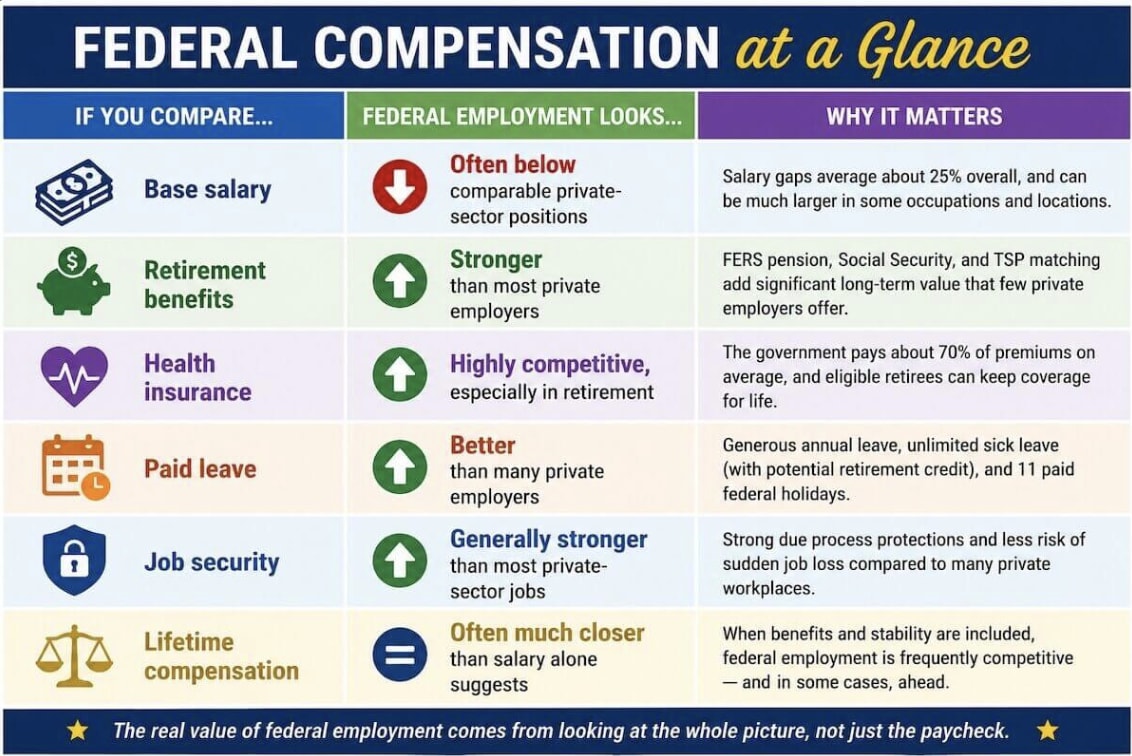
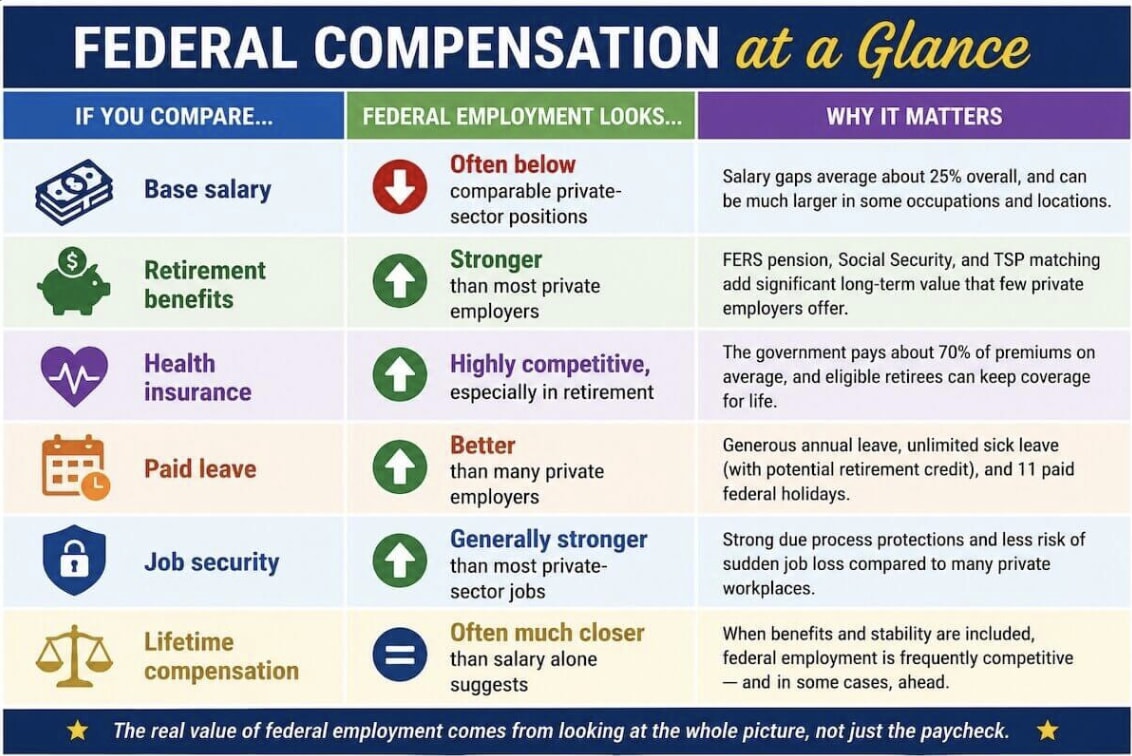
f you compare only salaries, federal employees often come up short. But if you look at the entire compensation package—including retirement, health insurance, paid leave, and job security—the picture becomes much more complicated.
Is Your Federal Salary Really Falling Behind?
According to the Federal Salary Council’s FY 2024 analysis using Bureau of Labor Statistics data, General Schedule employees earned an estimated 24.72% less than private-sector workers in comparable occupations. That’s an improvement from the previous year’s estimated 27.54% gap, thanks in part to larger pay raises in 2023 and 2024, but it is still a significant difference.
Recent annual raises illustrate the trend:
- 2024: 5.2% average increase
- 2025: 2% average raise
- 2026: 1% base + locality frozen at 2025 levels
- OPM General Schedule Pay Tables (Check out the pay for your grade, step, and locality to compare)
According to OPM data, federal salaries are now just over $112,000, although actual salaries vary widely depending on grade, occupation, experience, and geographic location.
For employees working in fields such as information technology, cybersecurity, engineering, healthcare, and other specialized professions, the gap can feel even larger. Many know former coworkers or classmates who left government service and quickly received substantial salary increases.
Based on salary alone, the evidence is fairly consistent. Federal pay often trails private-sector compensation for comparable work, particularly in highly competitive occupations and at senior levels. That is one reason agencies continue to face recruiting and retention challenges in some high-demand positions.
Why So Many Feel Federal Salaries are Too Low
Most employees do not usually compare their salaries with government reports or economic studies. They compare themselves with people they know or, perhaps, what they read from comments on the internet about federal employee salaries.
For example, a former coworker announces on LinkedIn that she accepted a new position with a major salary increase. A neighbor working for a defense contractor talks about annual bonuses and stock awards. A friend in cybersecurity explains that changing employers every few years has dramatically increased his income.
After hearing enough stories like these, it is easy to conclude that private-sector opportunities are always financially better.
The problem is that these conversations usually focus on annual salary.
Rarely does anyone mention how much they pay for health insurance, whether their employer offers a pension, how much they contribute toward retirement, or how much job security they enjoy. Few people calculate what those benefits will be worth over a 30-year career.
Individual stories can certainly be true. But they do not always (usually) provide a complete financial story. That is why perceptions about federal pay often differ from long-term compensation analyses.
The Part Most Pay Comparisons Miss
Salary is only one part of what employers provide.
Federal employees also receive retirement benefits, health insurance, paid leave, and workplace protections that have real financial value—even though they do not appear on an earnings statement.
When economists compare total compensation rather than salary alone, the gap between federal and private employment often narrows considerably.
Retirement: The Crown Jewel Benefit That Changes the Math
The Federal Employees Retirement System (FERS) remains one of the federal government’s strongest recruiting and retention tools.
It combines:
- A defined-benefit pension based on your high-three average salary and years of service
- Social Security
- The Thrift Savings Plan (TSP), including an automatic 1% agency contribution plus matching contributions of up to an additional 4% for most employees
Defined-benefit pensions have become increasingly uncommon in the private sector. Today, only a relatively small percentage of private-sector workers still have access to one.
That makes a significant difference over a full career.
Consider a GS-13 Step 10 employee in the Washington, DC area earning roughly $158,322 who retires after 30 years of service. That employee could receive a substantial lifetime pension, continue Federal Employees Health Benefits (FEHB) coverage into retirement if eligible, receive the FERS retirement supplement before becoming eligible for Social Security, and continue drawing income from a well-funded TSP account.

Read full article