
Veterinarian shortage poses screwworm vulnerability in South Texas

Veterinarian shortage poses screwworm vulnerability in South Texas
By: Alexandrea Bailey
A shortage of food animal practice veterinarians in South Texas could pose the risk of a regional resource strain amid the New World screwworm outbreak.
According to a report by the executive director of U.S. livestock technical services at Merck Animal Health, Justin Welch, 1.3% of registered veterinarians specialize in food animal practice. These veterinarians are qualified to inspect livestock, administer vaccines, and provide critical guidance on herd health.
“They support the viability of family farms, local economies, and the safety of the food on our tables,” Welsh writes. “Yet the United States has lost 90% of food animal veterinarians since the 1950s. And the number of these critical vets continues to decline.”
“We are doing everything we can,” said Dr. Lori Teller, executive director of the Texas Veterinary Medical Association (TVMA) and a licensed veterinarian in Texas.
Teller explained that the TVMA currently does not know the number of large animal veterinarians in specifically South Texas, but there is a workforce study underway to compile that much-needed data.
“I wish I could give you a number, but we don’t know,” said Teller. “We’d love to have that information for us, for the public, and for the legislature.”
The TVMA lobbied the Texas Legislature to make the study happen, and the Texas Higher Education board is the organization putting it together.
Teller says it should be complete by December, but there may be a preliminary report before then. She doesn’t know if the continued spread of New World screwworm will influence the report to be completed any faster, but it will determine funding needs.
However, the Texas Legislature won’t be making any decisions regarding the allocation of funds until their next session in January.
In the meantime, South Texas will have to make do with the few food-animal licensed practitioners in the area. Dr. Jared Hanselman with South Texas Large Animal Mobile Veterinary Services is one of the few. He says the shortage has been a problem for at least three decades, and Teller agrees.
Hanselman graduated in 2011 from Texas A&M University College of Veterinary Medicine, and remembers that even back then there were recruitment efforts to try to encourage qualified veterinarians to move to the Rio Grande Valley.
Similar initiatives are unfolding today, Teller said.

One thing the Texas legislature has done in terms of alleviating the shortage is fund the rural veterinary incentives program in order to incentivize graduates to provide rural veterinary care in underserved areas. The first recipients will be announced sometime in the next few weeks. Additionally the USDA provides funding for similar incentives. Teller foresees these efforts sparking change.
“It’s the first time the state has ever funded this program, so we are really looking forward to seeing the difference that can make,” Teller said.
To also help address the shortage, the Texas Animal Health Commission (TAHC) has a certification program in which people can become certified screwworm inspectors, and several hundred people are already participating, according to Teller.
Additionally, the Board of Veterinary Medical Examples is granting temporary licenses, and if needed the USDA can mobilize additional personnel in Texas.
“The more people that are qualified to inspect animals and determine if screwworm has infested an animal in that location, that helps direct the veterinary resources, so there are not a lot of false alarms, and that the resources can be concentrated in the areas where they are needed,” said Teller.
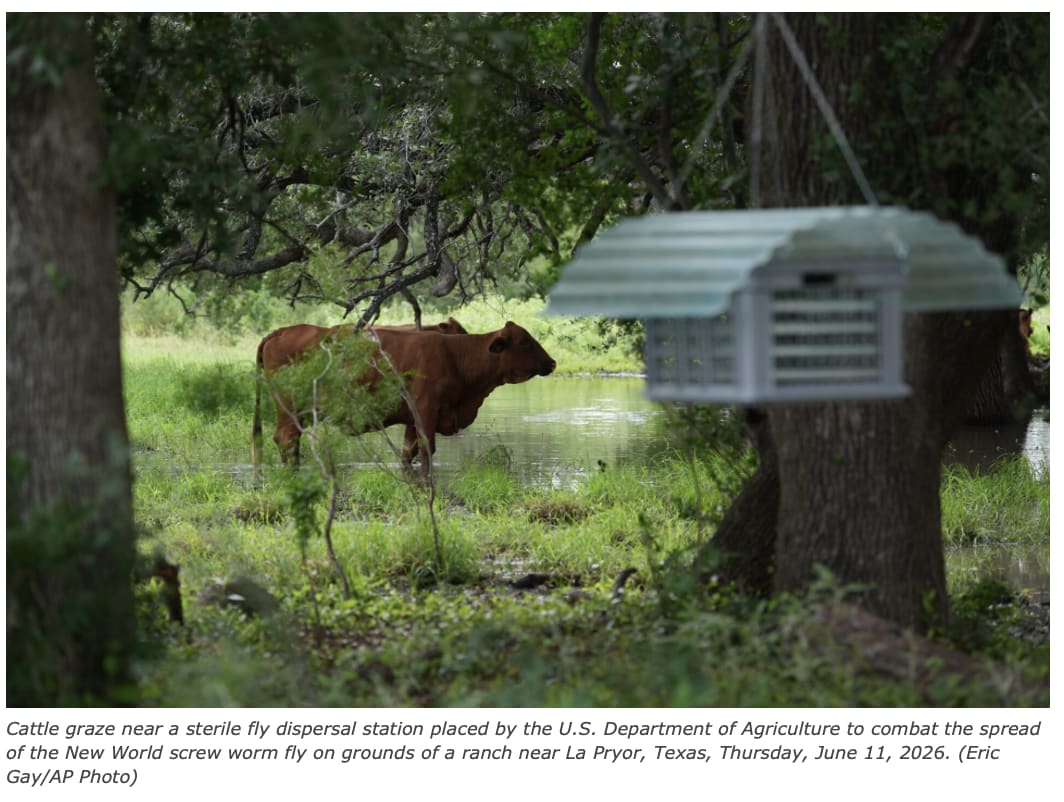
She added that this also helps determine where sterile flies need to be released to prevent the spread.
A silver lining is that a “significant” amount of Texas Tech graduates are going into rural veterinary practice, Teller has observed. She added that Texas A&M is also seeing an increase in graduates go into rural veterinary practice.
The shortage isn’t just in Texas.
Teller explained that it’s impacting other rural communities in regions across the U.S. where the agriculture industry is prominent.
According to Welsh’s report, more than 500 U.S. counties across 46 states are federally designated veterinary shortage areas.

Teller says one of the influences behind the shortage is the question of whether a rural community can actually support a veterinarian, or multiple, as well as provide career opportunities for their spouses and families. Many veterinarians are graduating with insurmountably seeming student debt.
“They need to be able to get the income that allows them to live a reasonable lifestyle and manage their debt,” said Teller.
Hanselman adds that it’s getting more and more difficult to get new veterinarians interested in working on large animals, particularly cattle.
“Cattle are hard labor, and it’s hard to get people talked into going out in the country, working and sweating,” he said. “It’s difficult work.”
Contradictory to what Teller said about increasing rates of veterinarian students pursuing large animal practice, Hanselman says in his experience, as more rural veterinarians are reaching retirement age, less and less personnel are taking their spots.
“There’s less of us and more cattle than veterinarians to tend to them,” he said.
He says from his perspective, the situation is leaving large animal veterinarians stretched thin. The biggest issue, he says, is getting possible New World screwworm samples submitted, while also formulating “a plan of attack” for infested farms.
He says treating screwworm is an intense and lengthy process. Just one confirmed case requires a veterinarian to spend 30 minutes to an hour on just one animal. If one property has multiple affected animals, the time the vet must allocate only multiplies.

But his “ultimate concern” is the supply chain for medication to treat and prevent New World screwworm.
“As long as we have a good supply chain for drugs to be able to treat this, we are in OK shape,” he said. According to Hanselman, the current supply and demand is manageable for the handful of cases detected thus far, but that could change if multiple ranches were to come down with infestations at once.
He says the day the first case of screwworm was detected in Texas, he was put on restrictions for ordering medications like Dectomax. He says the retainer only allows him to order six bottles, or 300 doses, per week.
“That’s nothing,” Hanselman said. “They started that from the get-go because they were worried about people panicking and hoarding.”
He foresees challenges arising as confirmed cases increase.
“Veterinarians are not going to be able to treat every single screwworm case that comes across the board,” he said. “We are going to have to instruct on how to treat the cases so the owner can actually do it themselves. It’s not going to be physically possible for us to do every single screwworm case that tests out positive.”
Hanselman says ranchers need to look for leisures, and invest in keeping their cattle in open areas where they can be monitored and are free from brush and other things that could possibly cause wounds or abrasions on their animals.
“Think outside the box when it comes to your pens and facilities,” he said. “If there is sharp edges or jagged areas that tend to scratch animals, they need to get that tended to before the next cow-working season.”
Hanselman also advises ranchers to take extra care monitoring newborn calves, as they are at high risk for umbilical infestation.
Behind the scenes, there’s been a great amount of coordination between state and federal entities to address screwworm. Teller says she has been taking part in daily phone calls with the USDA, FDA, and other involved agencies such as the TAHC, the Department of Human Health and Safety, and Texas Parks and Wildlife.
Teller says right now the most important thing for the public to know is that veterinarians are crucial to the prevention, diagnosis and treatment of the New World screwworm infestation.
“What’s really important is that people stay vigilant,” she said. “Check your animals regularly, and if you see something that concerns you, call your veterinarian or the Texas Animal Health Commission.”
Credit to the source